 Apps & Bits
Most agencies already have tools to compare quotes.
The problem is everything that happens before and after: intake, missing information, carrier portals, documents, AMS updates, and follow-up.
A producer or CSR takes a call, collects incomplete information, sends a follow-up email, waits for missing details, enters data into a rater, logs into carrier portals, re-enters information, downloads documents, checks underwriting questions, updates the AMS, and follows up with the prospect.
Some of that work happens inside a comparative rater.
A lot of it does not.
That is why carrier portal automation is becoming one of the most important workflow opportunities for independent insurance agencies.
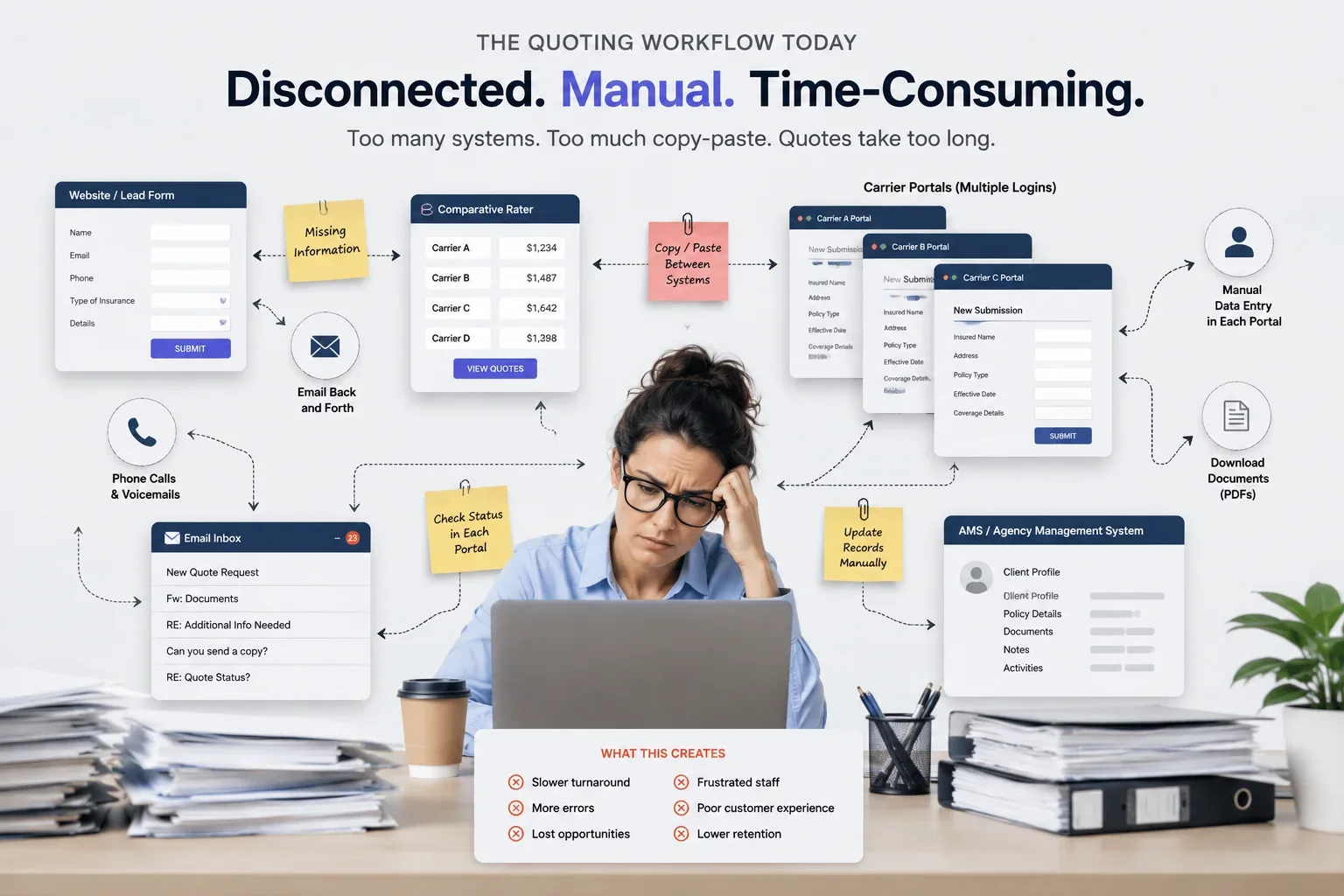
The rater is not the whole quoting workflow
Comparative raters are valuable.
They help agencies compare quotes, reduce duplicate data entry, and move faster across supported carriers.
But they are not a complete automation layer for the agency.
Most agencies still deal with work that falls outside the clean rater workflow:
- Intake from phone calls, emails, website forms, and referrals
- Missing information from the prospect
- Supplemental questions
- Appetite checks
- Carrier portal logins
- Document uploads
- PDF downloads
- Quote status checks
- Manual AMS updates
- Follow-up emails and SMS messages
- Exceptions that require a licensed agent to review
This is where quoting slows down.
The bottleneck is not always getting a quote. The bottleneck is everything around the quote.
Why carrier portals still matter
Insurance agencies work in a fragmented technology environment.
Some carriers integrate well with raters. Some support only certain lines of business. Some workflows are still handled inside browser-based portals. Some commercial lines processes still rely on documents, supplemental forms, and manual submission steps.
That means agency staff often move between several systems just to complete one quoting workflow.
A simple personal lines quote might involve:
- Capturing customer information
- Entering data into a rater
- Opening one or more carrier portals
- Confirming underwriting details
- Downloading quote documents
- Saving files to the AMS
- Sending options to the customer
- Following up if the customer does not respond
Commercial lines can be even more complex.
A small business quote may require industry classification, payroll, revenue, locations, prior loss history, supplemental forms, carrier appetite checks, and underwriter follow-up.
Even when a platform helps with part of the process, many agencies still end up copying information between portals, PDFs, emails, spreadsheets, and the AMS.
That is the manual layer agencies need to automate.
APIs are ideal. They are not always available.
When a carrier offers a modern API, that is usually the cleanest way to automate a workflow.
APIs are faster, more stable, and easier to monitor. They are the right answer when they exist and cover the workflow the agency needs.
But insurance workflows do not always live behind clean APIs.
Many important steps still happen in web portals. Agency staff log in, search for a policy, enter data, upload documents, download forms, check statuses, or retrieve quotes.
That creates a practical problem.
If the automation strategy depends only on APIs, the agency can automate only the workflows where APIs exist. The rest stays manual.
Browser automation fills that gap.
What browser automation means for insurance agencies
Browser automation uses software to operate web-based workflows in the same portals agency staff already use.
For quoting, that can include:
- Opening carrier portals
- Entering prospect or policy information
- Uploading required documents
- Pulling quote documents
- Checking quote status
- Capturing premium and coverage details
- Saving documents back to the AMS
- Flagging exceptions for human review
The goal is not to remove the agent from the process.
The goal is to remove repetitive portal work so the agent can focus on coverage, advice, and closing the account.
The best use case: automate the work outside the rater
Agencies do not need another disconnected tool.
They need an automation layer that works across the tools they already use: carrier portals, comparative raters, AMS systems, email, documents, and phone calls.
That is the key distinction.
A rater helps compare quotes.
Carrier portal automation helps complete the messy operational work around quoting.
The strongest automation strategy combines several layers:
- Use the rater where it works well
- Use APIs where they exist
- Use browser automation where workflows remain portal-based
- Keep a licensed agent in the loop for advice, review, and final decisions
This approach is more realistic than promising full end-to-end automation for every quote.
It also fits how agencies actually work.

Where quoting workflows break down
Most quoting delays come from a few recurring problems.
Incomplete intake
The customer says they want a quote, but the agency does not yet have enough information to quote accurately.
The CSR has to chase missing details. The prospect gets busy. The quote stalls.
Automation can help by capturing structured information from phone calls, website chats, SMS, and email before staff spend time on manual entry. A Lorina AI receptionist can also capture quote requests when staff are busy or the office is closed.
Duplicate data entry
The same information gets typed into multiple systems.
The AMS needs it. The rater needs it. The carrier portal needs it. A supplemental form needs it. The proposal needs it.
Every re-entry step costs time and increases the chance of an error. Better AMS connectivity can reduce the manual handoffs between intake, quoting, documents, and agency records.
Carrier-specific exceptions
One carrier asks for a detail another carrier does not. One portal has a required field. Another needs a document upload. Another requires manual review.
These small exceptions are hard to standardize, but they are practical candidates for human-in-the-loop automation.
Commercial lines complexity
Commercial quoting is less standardized than personal lines.
Business type, class codes, payroll, revenue, locations, prior losses, endorsements, and underwriting appetite can vary significantly by carrier.
This is why commercial lines agencies often still rely on manual workflows, even when they have modern tools.
Poor follow-up
Fast quoting does not help if the agency fails to follow up.
Many prospects need a reminder, a clarification, or a next step. If follow-up depends entirely on a busy CSR remembering to send another email, opportunities fall through the cracks.
Automation can trigger follow-ups, summarize quote status, and keep the producer or account manager focused on the accounts most likely to close.
What should not be automated blindly
Insurance quoting is not just data entry.
Some decisions require judgment.
Agencies should be careful not to automate:
- Coverage recommendations without licensed review
- Binding decisions
- Underwriting judgment
- Complex coverage comparisons
- Client-specific advice
- Exception handling without audit trails
The right model is not AI replacing the agent.
The right model is automation preparing the work, completing repetitive steps, and routing exceptions to the right person.
That is safer, more credible, and more useful.
A practical quote automation workflow
A modern insurance agency quoting workflow might look like this.
Step 1: Capture the request
A prospect calls, fills out a website form, sends an email, or replies to an SMS.
An AI receptionist or intake workflow captures the basic need and starts collecting structured information.
Step 2: Complete missing information
The system identifies missing fields and follows up automatically.
For example:
- Current carrier
- Renewal date
- Current premium
- Claims history
- Property details
- Drivers and vehicles
- Business type
- Revenue or payroll
- Locations
- Required documents
Step 3: Prepare the submission
The automation organizes the information for the agency’s workflow.
That may mean updating the AMS, preparing a rater entry, filling a supplemental form, or creating a task for a CSR.
Step 4: Run the supported rater workflow
If the agency uses a comparative rater, the automation can support the data preparation and post-quote workflow around it.
The rater remains valuable. It is simply not the only system involved.
Step 5: Automate portal-based work
For carriers or workflows that require portal access, browser automation can handle repeatable carrier portal steps.
That may include data entry, document upload, status checks, quote retrieval, and document download where APIs are limited or unavailable.
Step 6: Route exceptions to staff
If the portal asks for unusual information, if a field does not match, or if an underwriting question requires review, the workflow stops and routes the issue to a human.
This is important.
Reliable automation should know when not to continue.
Step 7: Update systems and trigger follow-up
Once quote documents or status updates are available, the workflow can update the AMS, notify the producer, and trigger customer follow-up.
This turns quoting from a manual sequence into a managed workflow.
Why this matters now
Insurance agencies are under pressure to respond faster.
Consumers expect quick answers. Producers want more time to sell. CSRs are overloaded. Carrier appetite changes. Renewal shopping is more common. Commercial submissions remain fragmented.
Adding another tool is not enough if staff still have to bridge the gaps manually.
The next phase of agency automation is not just about better quoting software.
It is about connecting the full quoting workflow.
That means intake, raters, carrier portals, AMS updates, documents, and follow-up.
The opportunity for independent agencies
Independent agencies do not need to rip out their existing stack.
They need automation that works with the systems they already use.
The agencies that benefit most are usually the ones with:
- High quoting volume
- Multiple carrier appointments
- Heavy portal usage
- Commercial lines workflows
- Renewal remarketing pressure
- CSRs spending too much time on data entry
- Producers waiting on quote status updates
- Missed follow-up opportunities
For these agencies, the value is not abstract.
It is fewer manual steps, faster turnaround, cleaner handoffs, and more time spent advising clients. Similar principles apply to renewal automation, where remarketing, document handling, status tracking, and follow-up also cross multiple systems.
Where Apps & Bits fits
Apps & Bits helps independent insurance agencies automate the quoting work that happens outside the rater.
That can include quote intake, missing information follow-up, browser-based workflows, document handling, AMS updates, and producer handoffs, with exceptions routed to your team.
The point is not to replace your comparative rater, AMS, or licensed team.
The point is to connect the manual steps between them.
If your agency is spending too much time copying information between quote requests, raters, carrier portals, PDFs, and your AMS, explore our insurance quote automation solution.
The bottom line
Automated quoting is not just about generating rates.
It is about removing the manual work that surrounds the quote.
Comparative raters help agencies compare options. APIs help where carriers support them. Browser automation fills the gap where the work still happens in portals.
That missing layer is where many agencies can unlock the next level of efficiency.
The best automation does not replace the agent.
It gives the agent a cleaner, faster, better-prepared workflow — so the agency can quote faster without sacrificing judgment, accuracy, or client service.