 Apps & Bits
 California homeowners are seeing more insurance notices than they are used to. Some receive a nonrenewal notice. Others receive a cancellation notice. Some receive a renewal offer with a much higher premium. Others see coverage reductions, underwriting requests, or billing-related warnings.
To the client, all of these can sound the same: “I got dropped.”
For brokers, that phrase is not enough. The first step is to identify what actually happened. A nonrenewal, cancellation, renewal offer, and nonpayment notice all have different meanings, timelines, and next steps. That distinction matters because the wrong explanation can create panic, missed deadlines, or unnecessary work.

Why clients confuse nonrenewal and cancellation
Most homeowners do not read insurance notices closely. They see the carrier name, a date, and a message that feels threatening. In a difficult California home insurance market, even a routine renewal change can trigger anxiety. Clients may assume they are losing coverage when they are actually being offered renewal at a higher price. Others may think they have months to solve the problem when the notice is actually a cancellation with a shorter timeline.
That is why brokers need to slow the conversation down. Before discussing replacement coverage, FAIR Plan, wildfire risk, or carrier strategy, the broker needs to answer one basic question: What type of notice did the client receive?
The four notices brokers should separate immediately
1. Nonrenewal
A nonrenewal means the carrier is not continuing the policy at the end of the current policy term. The policy is still active until the expiration date, assuming premiums are paid and no other issue arises. The carrier is saying it will not offer another term after that date.
Common reasons may include wildfire exposure, property condition, claims history, roof age, or carrier pullbacks in a region. For the client, the key message is: You still have coverage today, but we need to act before the expiration date.
2. Cancellation
A cancellation means the carrier is ending the policy before the normal expiration date. This is different from a nonrenewal. It usually carries more urgency because the timeline may be shorter and the policy may terminate midterm.
A cancellation can involve issues such as nonpayment, material misrepresentation, property condition issues, or underwriting issues discovered after binding. For the client, the key message is: This is more urgent than a nonrenewal because the policy may end before the normal expiration date.
3. Renewal offer with a major premium increase
Not every alarming renewal notice is a nonrenewal. Sometimes the carrier is offering renewal, but at a significantly higher premium. For the client, the key message is: The carrier is still offering coverage, but we should review whether the renewal is still the best option.
4. Renewal offer with coverage reduction
A renewal offer may also include reduced limits, removed coverage, or new exclusions. This can be easy for clients to miss. The policy may still renew, but with materially different protection. For the client, the key message is: You may still have a renewal option, but the terms may have changed. We need to review what changed before you accept it.
The first thing to tell the client
When a homeowner sends a notice, the broker’s first response should be calm, direct, and procedural. A strong first response might sound like this:
I reviewed the notice. The first thing we need to do is classify it correctly. A nonrenewal, cancellation, renewal increase, and coverage change all require different next steps. I’m going to confirm the notice type, the effective date, and the carrier’s stated reason. Then we’ll decide whether to challenge it, replace it, or compare renewal options.
Why the effective date drives everything
Every notice should be reduced to three facts:
- What type of notice is it?
- What is the effective date?
- What reason did the carrier give?
The effective date determines the workflow. If it is a nonrenewal, the agency has time to review, challenge, and remarket. If it is a cancellation, the agency may need to act much faster. That distinction helps the agency avoid wasting time on the wrong workflow.
The California timing issue brokers should flag
California has specific notice rules for residential property insurance. For nonrenewal notices, carriers generally require more advance notice than many clients expect. Nonpayment cancellation has its own shorter timeline.
Do not assume the timeline. Read the notice. Confirm the date. Document the file.
If a notice appears late, unclear, or inconsistent, the broker should escalate internally and contact the carrier.
Wildfire-related notices need an extra check
In California, wildfire-related nonrenewals and cancellations may require additional review. If the carrier cites wildfire risk or brush, check whether any wildfire-related protections, moratoriums, or mitigation documentation may apply.
The key is to avoid treating wildfire nonrenewals as purely administrative notices. They often require documentation, timing review, and client education.
The broker’s practical workflow
A strong agency workflow should classify the notice before deciding what to do next.
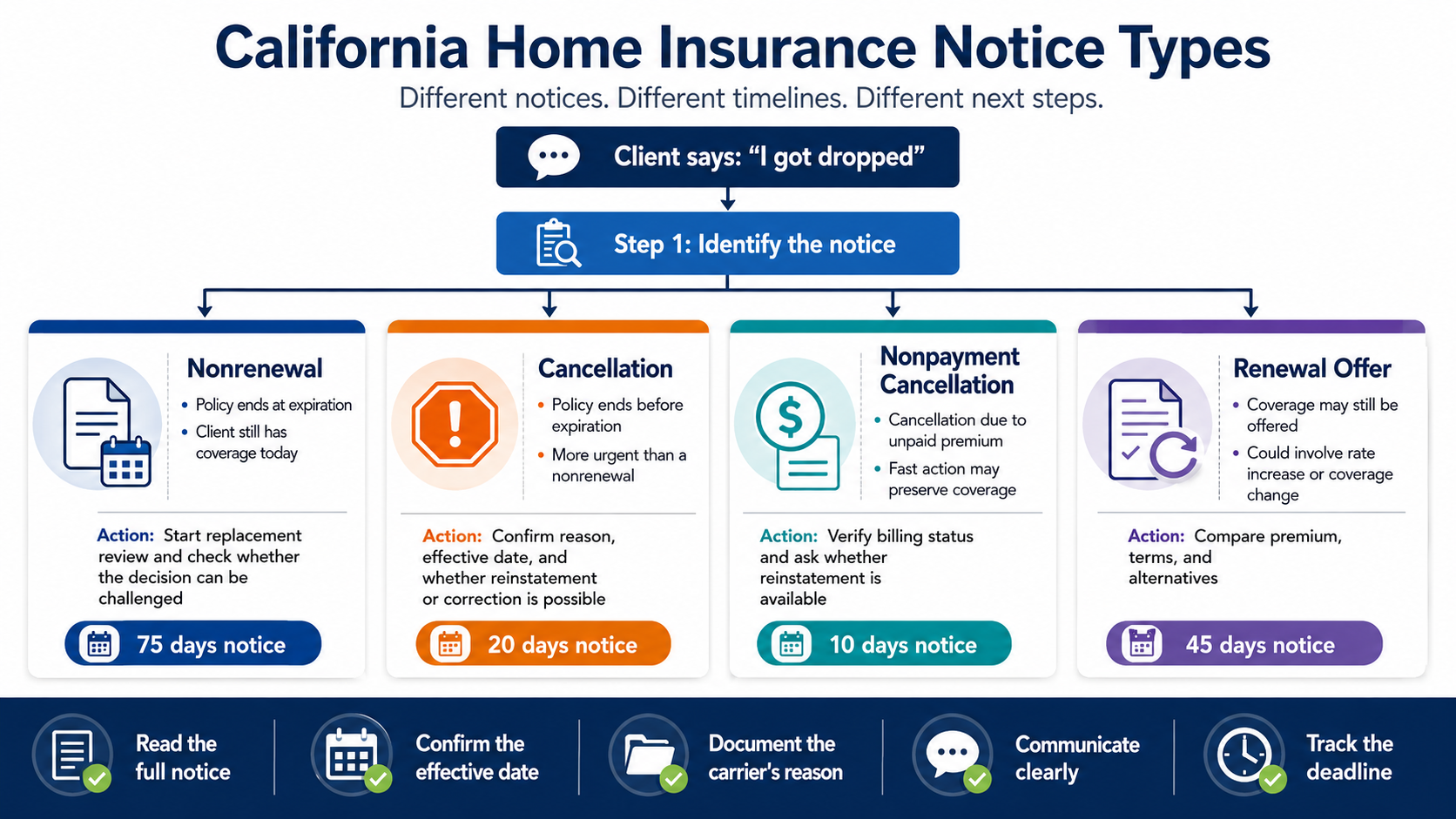
- Collect the notice: Ask the client to send the complete PDF, not just a screenshot.
- Classify it: Nonrenewal, cancellation, renewal offer, or coverage change.
- Capture the dates: Expiration date, cancellation date, and mailing date.
- Extract the reason: Copy the carrier’s stated reason into your AMS.
- Decide the track: Reconsideration, reinstatement, marketing, or renewal comparison.
- Communicate in writing: Send a short written recap of the facts and next steps.
- Track the deadline: Create a task before the effective date, not on the effective date.
Automate the Handoff
Managing these notices can be an operational drain. Apps & Bits helps agencies automate the repetitive parts of this process—from capturing the initial notice to preparing organized summaries for your staff.
See our Insurance Automation Solutions →
The bottom line
When a California homeowner says, “I got dropped,” brokers should not assume the answer. The best broker communication is calm, specific, and process-driven. Identify the notice, confirm the date, and start the right workflow immediately. That is the conversation clients need most.