 Apps & Bits
The California FAIR Plan was built as a last-resort safety net. But as more homeowners and businesses are pushed toward it, insurance agencies are absorbing the day-to-day burden: incomplete submissions, missing documents, inspection follow-ups, payment questions, renewal reviews, claims intake, and anxious client calls.
For California homeowners, the FAIR Plan is often described in simple terms: the place to go when traditional fire insurance is no longer available.
For insurance agencies, it is anything but simple.
As wildfire risk reshapes the state’s property insurance market, the California FAIR Plan has become a growing part of daily agency operations. What was once a backstop for hard-to-place properties is now a recurring workflow for many producers, CSRs, and account managers.
The pressure shows up in small, repetitive tasks: a missing document, a status check, an inspection follow-up, a payment question, a renewal comparison, a client asking whether the FAIR Plan is the same as homeowners insurance.
It is not.
The FAIR Plan is California’s insurer of last resort for basic property insurance. It was created in 1968 and operates as a private, statutorily created association of insurers licensed to write property and casualty business in California. It is not a state agency and does not use taxpayer funding. Its purpose is to make basic property insurance available when coverage cannot be obtained through the normal market.
That distinction matters because the FAIR Plan is not designed to be a full replacement for a standard homeowners policy. It is a safety net. And increasingly, that safety net is creating a heavy operational burden for the agencies that help clients navigate it.
A safety net under pressure
The FAIR Plan’s growth has been substantial.
As of March 2026, the plan reported $750 billion in total exposure, 684,388 policies in force, and $2.02 billion in written premium. FAIR Plan materials attribute that growth to climate-driven wildfire risk and reduced availability in the voluntary insurance market.
The concentration is even more striking in wildfire-exposed counties. State residential policy data cited in the research shows the FAIR Plan represented about 3.7% of new and renewed residential policies statewide in 2023. In counties above the 50th percentile for wildfire risk, that share rose to about 10%. In the top 10 wildfire-risk counties, it reached 32.6%.
For consumers, those numbers help explain why the FAIR Plan is showing up more often in insurance conversations.
For agencies, they explain something else: why the workload is growing.
Every FAIR Plan case can become a project. A homeowner may arrive after a non-renewal. A property may require photos, a rebuild estimate, additional documentation, or inspection follow-up. A client may need to understand the difference between FAIR Plan coverage and Difference in Conditions coverage. A renewal may require comparison against prior terms and another search for private-market options.
None of that fits neatly into one system.
The work behind the policy
The FAIR Plan application path is more inspection-driven than many standard insurance workflows.
According to the research, the plan provides for a prompt inspection. The inspection report must be transmitted within five days after completion, and the placement facility must issue an action report within three business days after receiving the inspection report and request. But the research also notes that the FAIR Plan does not publish a consistent end-to-end new-business turnaround time. Total timing can depend on inspection scheduling, document completeness, reinspection, underwriting, and premium payment.
That uncertainty becomes agency work.
Someone has to track what was submitted. Someone has to follow up on missing documents. Someone has to check status. Someone has to answer the client’s question when nothing appears to be moving. Someone has to update the AMS. Someone has to remember whether the file is waiting on the client, the FAIR Plan, a broker review, an inspection, a payment, or a companion policy.
The problem is not only the FAIR Plan application itself. It is the chain of work around it.
The research identifies several operational pain points for agencies: fragmented intake, inspection follow-up, manual rekeying, endorsements, renewals, wildfire documentation, and FAIR/DIC coordination.
That is where the burden lands: not in one dramatic bottleneck, but in dozens of small administrative steps repeated across many clients.
The coverage gap creates more questions
Part of the workload comes from consumer confusion.
A FAIR Plan dwelling policy is fundamentally a named-peril fire policy, not a full homeowners package. The research summarizes the baseline covered perils as fire or lightning, internal explosion, and smoke. Optional coverages may add other specific perils, such as windstorm or hail, riot or civil commotion, vehicles, aircraft, volcanic eruption, and vandalism or malicious mischief if selected.
But common homeowners coverages are not automatically included.
Liability, theft, and non-weather water damage are major gaps compared with standard homeowners coverage. That is why FAIR Plan coverage is often paired with Difference in Conditions coverage, or DIC, and sometimes with separate earthquake or flood coverage depending on the property and risk.
For a homeowner, that may sound like fine print.
For an agency, it becomes a workflow.
The team has to explain what the FAIR Plan does and does not cover. It may need to coordinate FAIR Plan and DIC submissions. It may need to compare policy terms, collect documents twice, keep data consistent across systems, and make sure the client understands what still needs review.
The agency is not just selling or servicing a policy. It is guiding a client through a fragmented insurance path.
The post-wildfire workload
Wildfires add another layer.
In the February 2025 assessment order cited in the research, the FAIR Plan reported 4,794 Palisades and Eaton fire claims, $4.039 billion in total incurred losses, and a need for a $1 billion assessment on member insurers, the first such assessment in more than 30 years. The Department of Insurance also pursued legal action over smoke claims in 2025, alleging at least 418 violations of consumer protection laws.
The California Department of Insurance announced formal legal action against the FAIR Plan in July 2025, saying the department was responding to wildfire survivor complaints over smoke damage claims following the Palisades and Eaton fires.
For agencies, wildfire events create sudden spikes in calls, documentation, claims intake, and follow-up. Clients may need to report damage, submit photos, understand next steps, ask about fair rental value, or clarify what their policy does and does not cover.
In that environment, a voicemail, a scattered inbox, or a vague note is not enough.
Agencies need structured intake. They need clean handoffs. They need to know what information has been collected, what is missing, and who owns the next step.
A workflow problem, not just an insurance problem
The FAIR Plan is often discussed as a market problem. And it is one.
But inside an agency, it is also an operational problem.
A single FAIR Plan case can touch:
- Phone calls
- Emails
- PDFs
- Photos
- Rebuild estimates
- Payment questions
- Inspection status
- Renewal tasks
- Endorsement requests
- DIC coordination
- AMS records
- Producer follow-ups
- CSR service queues
That work is usually spread across systems that were not designed to coordinate automatically.
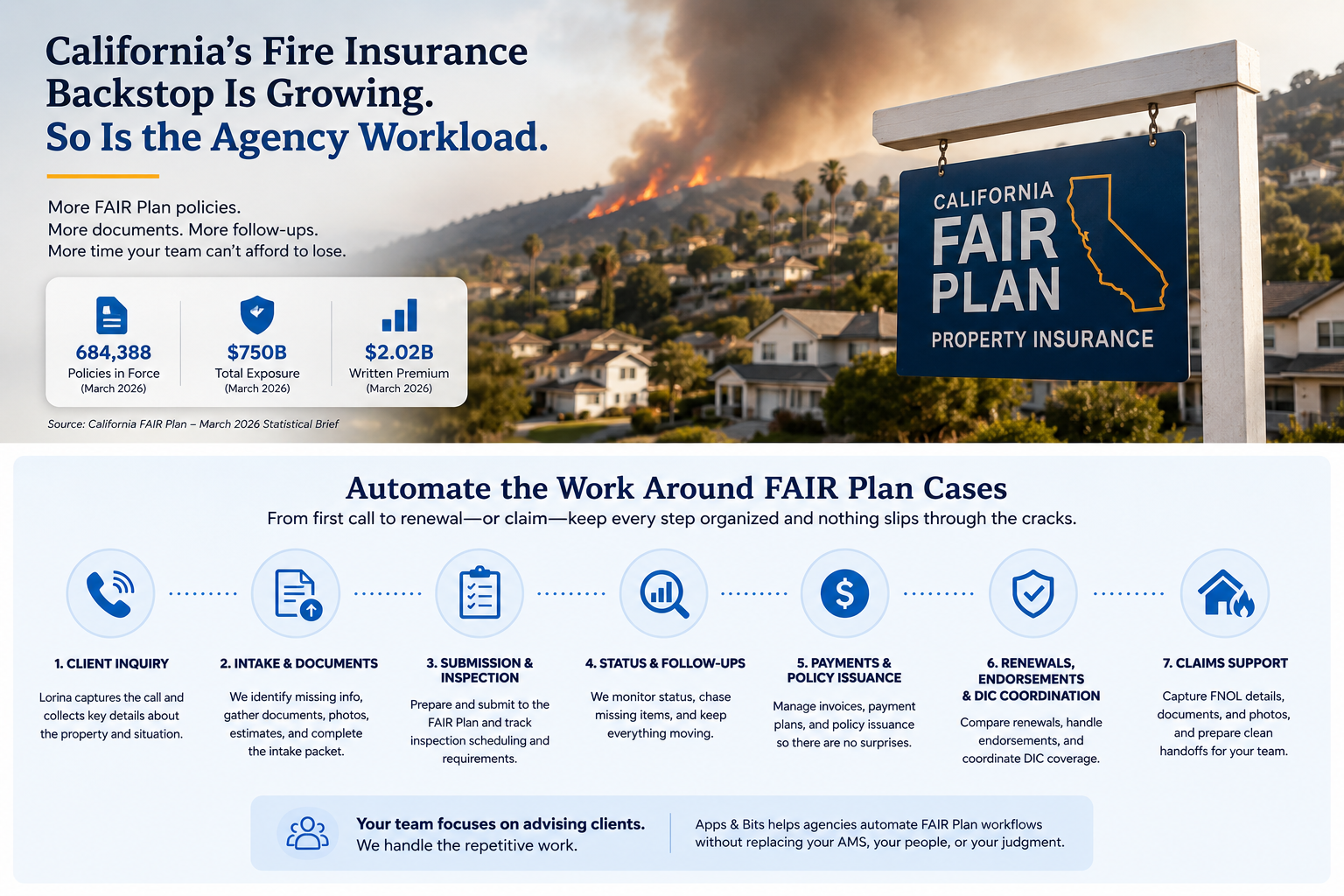
This is where automation can help, as long as it is applied to the right part of the process.
Automation should not replace broker judgment. It should not provide coverage advice. It should not decide whether a client needs the FAIR Plan, DIC, earthquake, flood, or another option.
But it can reduce the repetitive work around the decision.
An AI receptionist can capture FAIR Plan-related calls and create structured summaries. Insurance quote automation can help structure inquiry intake and submission details. Renewal automation can compare terms. Claims intake automation can organize first-notice-of-loss details. AMS connectivity can prepare notes and tasks for review.
The human still advises the client. The system reduces the administrative drag.
The agency opportunity
The agencies that handle FAIR Plan work well will not simply be the ones with the most market knowledge.
They will be the ones with the cleanest workflows.
They will know which clients are waiting on documents. Which cases need inspection follow-up. Which renewals need review. Which claims need photos. Which payments are outstanding. Which accounts need a conversation about DIC. Which files are ready for a producer or account manager to review.
That level of operational clarity matters because the FAIR Plan is not likely to disappear from agency workflows soon.
California’s property insurance market remains under pressure. Regulators are pursuing reforms to push more policies back into the admitted market, and the FAIR Plan clearinghouse is designed to help move eligible risks back to private coverage when possible. But availability remains uneven and depends on the specific property, location, and market appetite.
In the meantime, agencies are left managing the work.
What to automate first
For agencies handling a growing number of FAIR Plan cases, the best starting point is usually not a large transformation project.
It is one painful workflow.
Start with the part of the process where staff are losing the most time:
- FAIR Plan inquiry intake
- Missing document follow-up
- Submission packet preparation
- Status checks
- Inspection follow-up
- FAIR and DIC coordination
- Renewal comparison
- Endorsement servicing
- Wildfire claims intake
- Billing and payment exception tracking
- AMS-ready summaries and tasks
The core question is simple:
Where is your team spending time chasing information instead of advising clients?
That is the workflow to automate first.
The bottom line
The California FAIR Plan was created as a last-resort safety net.
But for many insurance agencies, it has become something else: a growing source of manual work.
Submissions, documents, inspections, status checks, payments, renewals, endorsements, claims, and client follow-ups are now part of the daily operating burden around wildfire-exposed property insurance.
The answer is not to remove the broker, the CSR, or the producer from the process.
It is to stop making them chase every status, document, invoice, and portal update by hand.
For California agencies, the next competitive advantage may not be just access to coverage. It may be the ability to manage the workflow around that coverage with speed, structure, and less administrative friction.
Handling more FAIR Plan cases?
Apps & Bits helps insurance agencies automate the repetitive operational work around California FAIR Plan workflows, including intake, missing documents, status checks, renewals, claims, billing, and AMS-connected handoffs.
Book a Free AI Audit and we will help identify one practical workflow to automate first.