 Apps & Bits
 California’s homeowners insurance market has created a new kind of client conversation.
It is no longer just: “Can we find coverage for this property?”
Increasingly, it is: “What exactly is covered, under which policy, by which carrier, with which deductible, and what happens at claim time?”
That shift matters because more California homeowners are being pushed toward the California FAIR Plan. The California Department of Insurance describes the FAIR Plan as an option for California residents and businesses who cannot obtain insurance through a regular insurance company. But the FAIR Plan is not the same thing as a standard homeowners policy. It is a limited property insurance product, and many homeowners need a separate Difference in Conditions policy, often called a DIC policy, to fill major coverage gaps.
For consumers, this is confusing. For agencies, it creates more explanation, more documentation, more follow-up, and more risk of misunderstanding.
 As more California homeowners move into FAIR Plan coverage, agencies are spending more time explaining what is covered, what is excluded, and where DIC policies fit.
The FAIR Plan is not a standard homeowners policy
The biggest misconception is simple: many consumers hear “FAIR Plan” and think they have homeowners insurance. That is not quite right.
The FAIR Plan is designed as basic property insurance for people who cannot find coverage in the regular market. According to the California Department of Insurance, the current FAIR Plan residential option remains a limited fire policy, and a broader residential option is still “in progress.” CDI also notes that policyholders who want coverage for water damage, liability, theft, additional living expenses, and other common coverages may need to purchase a separate DIC policy.
That distinction is critical. A homeowner may have coverage for fire-related losses, but still lack coverage for issues they normally associate with a homeowners policy, such as:
- Water damage
- Theft
- Liability
- Certain living expenses after a loss
- Some non-fire property claims
The problem is not that the FAIR Plan has no value. It does. For many California property owners, it may be the only available path to fire coverage. The problem is that consumers often think the coverage conversation is finished once the FAIR Plan is bound. In many cases, it is not.
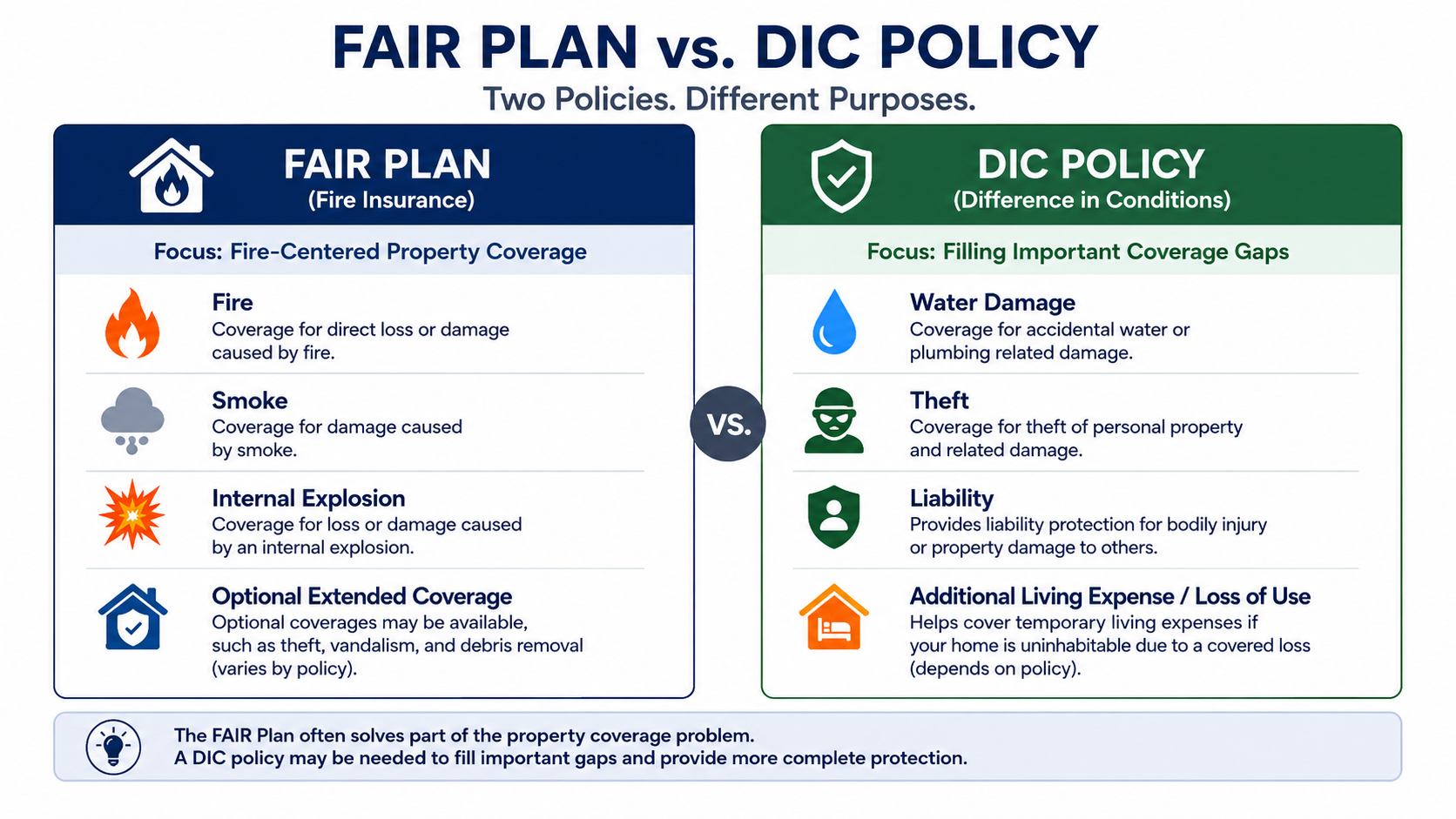 The FAIR Plan often solves part of the property coverage problem. A DIC policy may be needed to fill important gaps.
Where DIC policies fit in
A Difference in Conditions policy is meant to complement the FAIR Plan. The California Department of Insurance maintains a list of insurers that sell DIC policies, and the FAIR Plan itself explains that DIC policies can provide coverages not available through the FAIR Plan, such as water damage, theft, and liability.
In plain English:
- The FAIR Plan often handles the fire-centered part of the problem.
- The DIC policy may handle parts of the “everything else” problem.
But that does not mean every FAIR Plan + DIC package equals a standard homeowners policy. The actual coverage depends on the forms, endorsements, limits, exclusions, deductibles, and how the two policies interact. Some DIC policies may be structured as companion policies. Others may work more like a homeowners-style policy with fire carved out. That means agencies cannot rely on the label “DIC” alone; they need to review the actual policy structure.
Why this creates more work for agencies
This is where the operational burden shows up. A standard homeowners policy is already complex. But a FAIR Plan + DIC setup can turn one coverage conversation into several parallel workflows:
- The agency has to explain what the FAIR Plan does and does not cover.
- The agency has to explain why the client may need a DIC policy.
- The agency has to coordinate two applications, two declarations pages, two sets of limits, and often two renewal timelines.
- The agency has to document that the client understands the gaps.
- The agency has to help the client understand which carrier handles which type of claim.
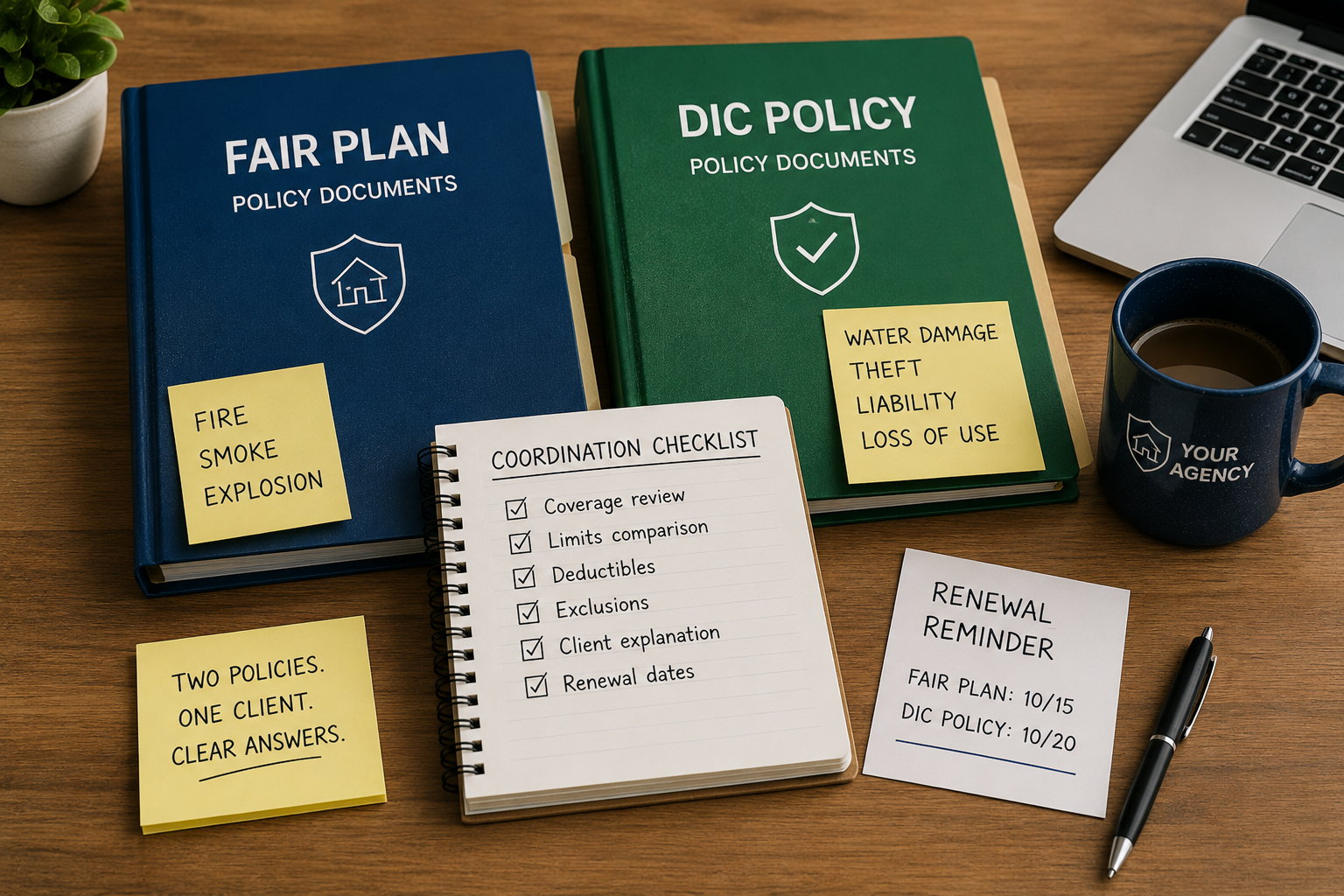 For agencies, FAIR Plan + DIC creates a coordination problem: two policies, two sets of documents, and one client who needs a clear explanation.
The most common consumer misunderstandings
The same questions keep coming up:
“I have the FAIR Plan. Does that mean I have homeowners insurance?” Not in the traditional sense. The FAIR Plan is an important coverage option, but CDI describes the current residential option as limited.
“Does my DIC policy cover fire?” Often, no. Many DIC structures are designed to fill gaps around the FAIR Plan, not replace it.
“If I have both policies, am I fully covered?” Not automatically. The combination may approximate a traditional package, but the result depends on how both policies are written.
“If I have a loss, who do I call?”
This is where agencies become essential. A fire claim, water claim, theft claim, smoke claim, or mixed-cause loss may not all follow the same path. The client needs clear instructions before a loss happens, not after.
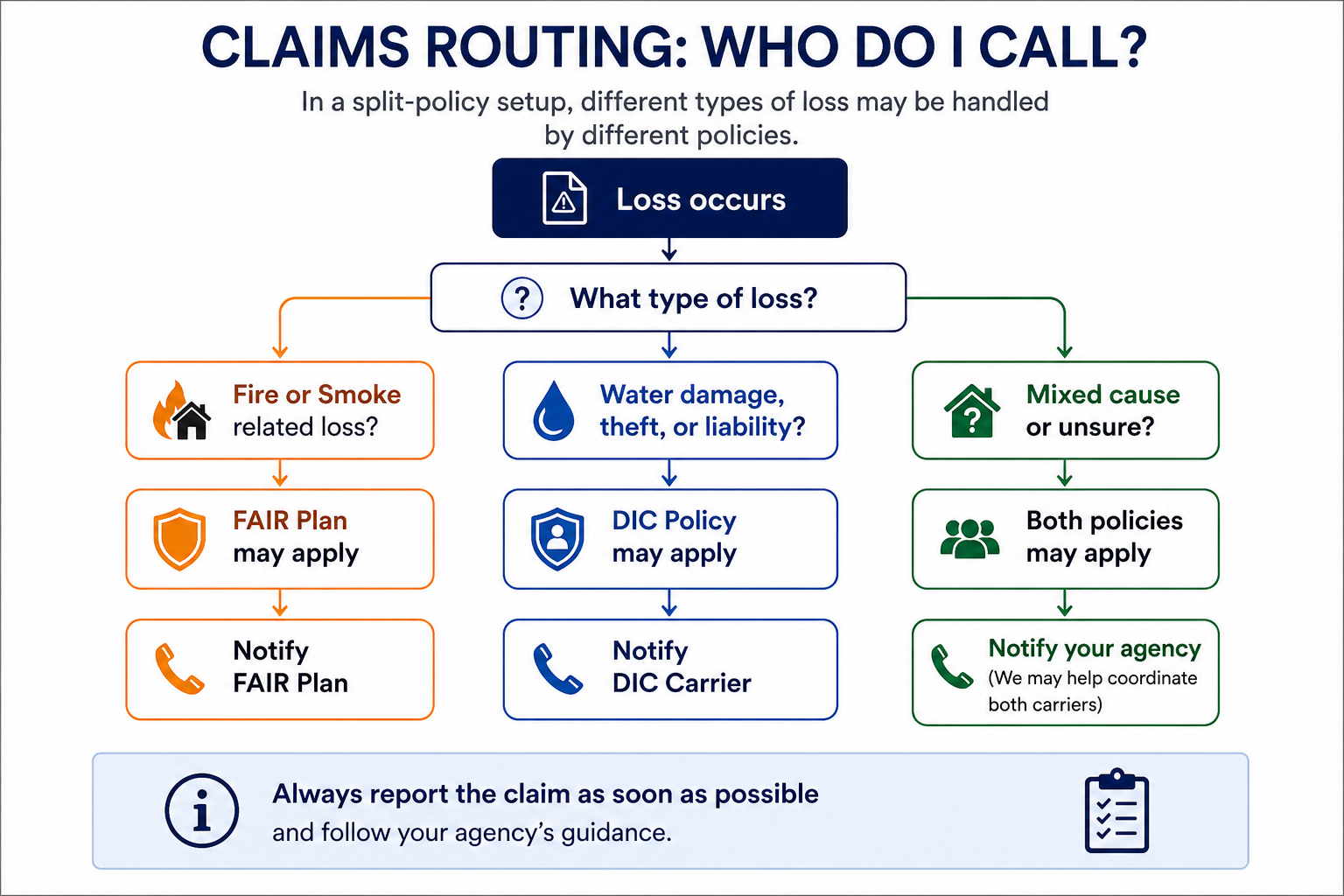 In a split-policy setup, claim routing can become confusing unless the agency documents the process clearly.
The hidden risk: two policies, one confused client
The biggest risk is not simply that a client lacks coverage. It is that the client believes they have coverage they do not actually have. That misunderstanding can happen when a homeowner assumes the agency “got them insured” once they see the FAIR Plan policy.
For agencies, this creates E&O exposure and service burden. A good agency process should make the split clear:
- What the FAIR Plan covers
- What the DIC policy covers
- Which deductibles apply
- Which carrier handles which claim
- What the client should do after a loss
Why this topic is becoming more important now
The FAIR Plan was once a relatively narrow safety net. Today, it is part of the normal coverage conversation in many California markets. Wildfire risk, carrier pullbacks, and rising premiums have pushed more households into non-standard structures. As that happens, independent agencies are spending more time explaining coverage architecture.
What agencies should do now
Agencies that handle FAIR Plan + DIC placements should treat them as a structured workflow, not a one-off exception. At minimum, every file should include clear summaries, tracking for both renewal dates, and client-facing explanations.
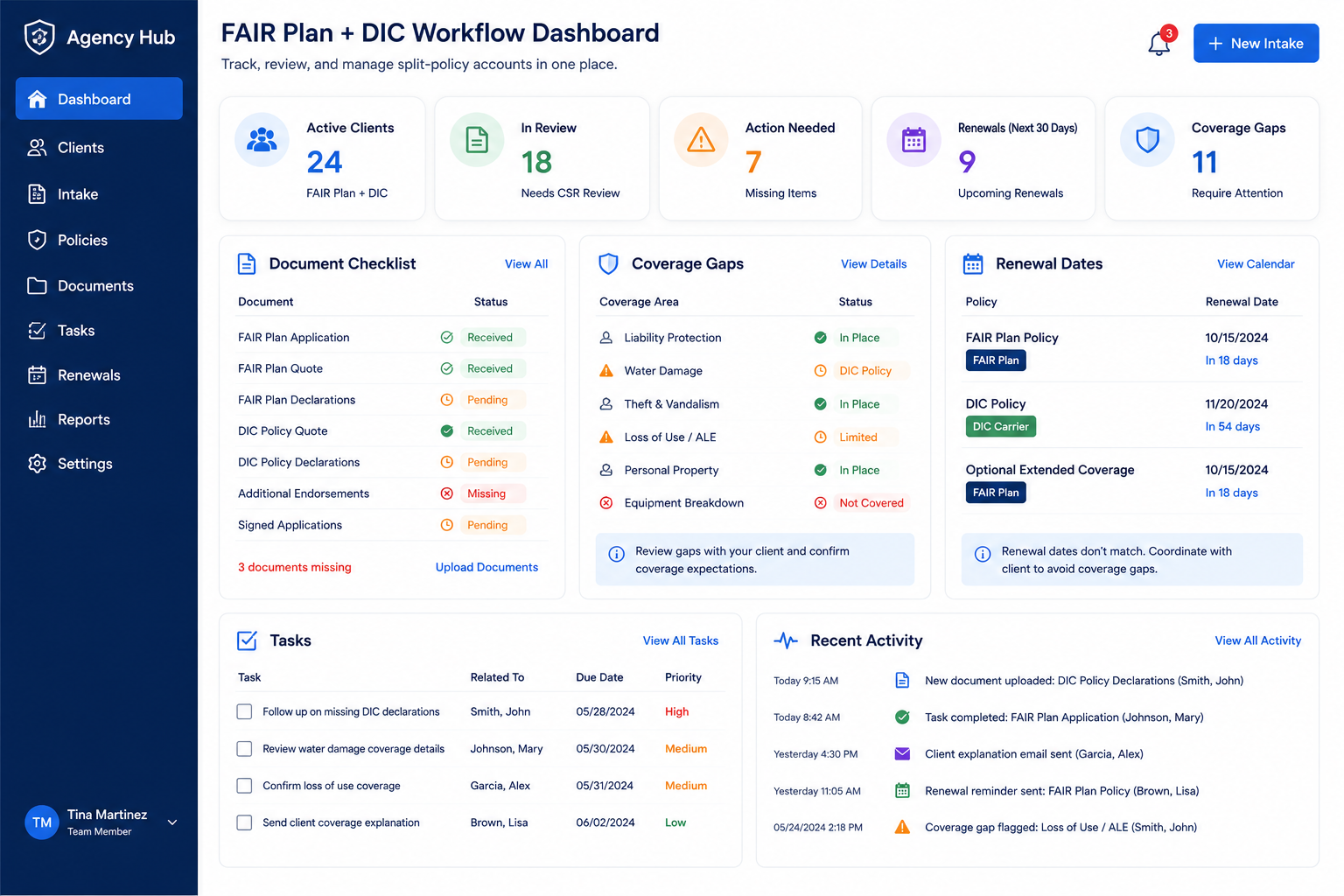 The operational challenge is not just coverage placement. It is intake, document review, gap tracking, follow-up, and renewal coordination.
Automate the complexity
If your team is losing too much time to split-policy coordination, Apps & Bits can help. We build focused workflows that automate the repetitive parts of FAIR Plan and DIC cases—from intake and document review to client-friendly gap checklists.
See how we automate FAIR Plan + DIC workflows →
The bottom line
FAIR Plan + DIC coverage is not just an insurance placement problem; it is a communication and workflow problem. As more California homeowners move into split-policy structures, agencies will need better ways to explain coverage, coordinate documents, and track renewals. The coverage conversation is getting more complicated. The agency workflow needs to catch up.